
ABOUT
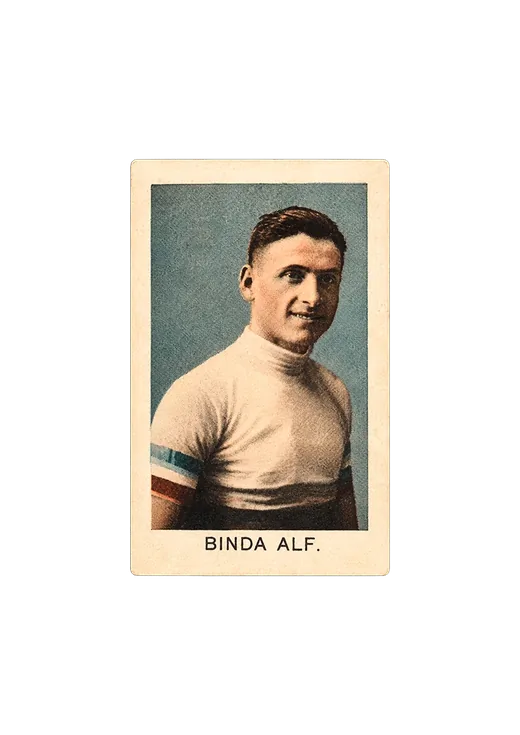
Look at the sleeve. The band of colour running round Alfredo Binda's arm is the rainbow of a world champion, and Binda won that jersey three times — 1927, 1930 and 1932. It is the only thing on the card that carries a date, and it only gives a floor: the portrait cannot be earlier than 1927, and the archive places the card in 1934, by which time Binda was at the end of a career that had made him the most dominant Italian rider of his generation. La Felsinea, of Bologna, is recorded in the pre-war literature mainly for a different series: a set of figurine made for the Berlin Olympics of 1936, Sport olimpionici. The cycling cards sit outside that, undocumented, and nothing in the record gives a count, an album or a size for them. So the total stays blank, and the 1934 date is an attribution read off the picture rather than a printed year. The card itself is a small masterpiece of cheap colour: a hand-tinted photograph, the jersey left white, the background washed in flat blue, the name in plain capitals on a strip at the foot. BINDA ALF. — surname first, the way an Italian register would write it. The whole visual language of the Italian figurina is already here, four years before Zaini and Lurati were still printing it almost unchanged, which is one reason this is among the oldest things in the archive.
Sources
Cyclisme
Year 1934
Publisher La Felsinea
Country Italy
Cyclists listed 13
Total cards —
Format —
WRAPPER
No image
List
Partial list: cards seen for sale, no album or checklist known
- {{ row.number }} {{ row.name }} {{ row.team }}